PEVO safety recommendations on moves with bucket trucks
Updated on
August 24, 2026
Updated on
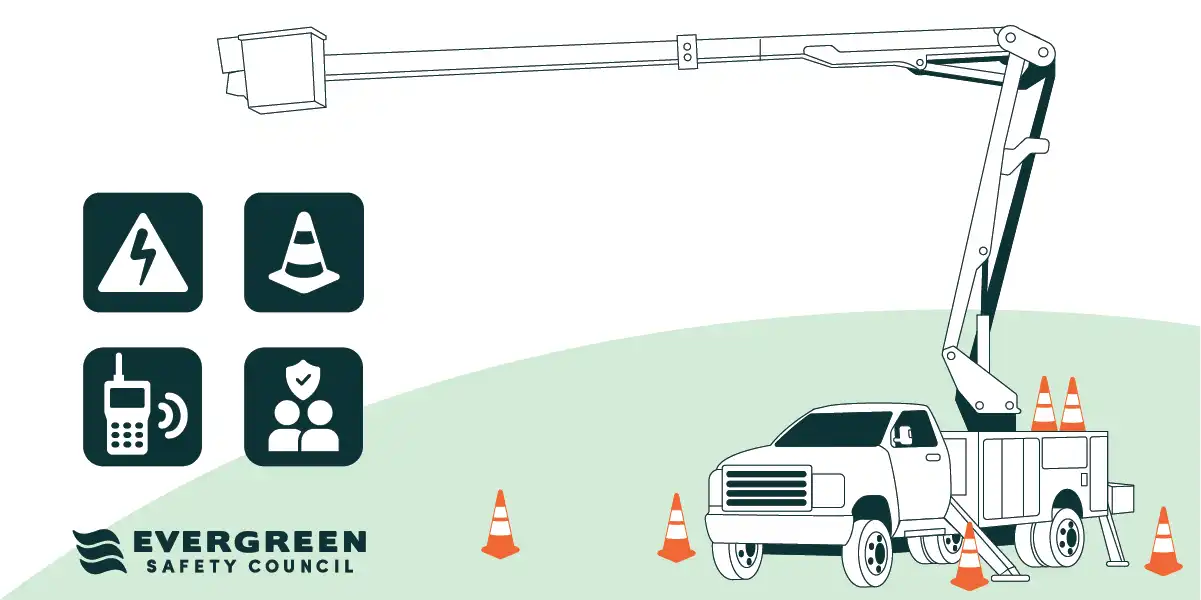
When a load is overheight, it may risk striking utility or power lines along the route. If there is a utility or power line that needs to be lifted in order to make room for an overheight load along a particular route, it is likely that a bucket truck crew will be called on to assist.
Some power lines carry enough electricity to injure or kill someone who comes too close to them—even without touching them. In Evergreen Safety Council’s Washington PEVO certification classes, we teach our Pilot/Escort Vehicle Operators (PEVOs) that they should never lift a line, and to treat all lines as potentially hazardous.
Bucket trucks (named for their built-in, bucket-shaped personnel lifts) are designed to withstand electric currents, and their operators have special equipment, PPE, and training that allows them to safely work around utility or power lines. During a bucket truck operation, the trained crew will establish an exclusion zone boundary—an area that should be kept free of other people and vehicles besides the bucket truck team, in order to keep everyone safe.
A PEVO's role during a bucket truck operation will usually be warning or signaling to traffic, as well as communication relay.
Here are a few key recommendations for PEVOs working with bucket truck crews.
If a line will need to be lifted along a route, this should be discussed up front. During the pre-trip meeting, the PEVOs and load driver should take a close look at the location of the obstruction, and determine where they should safely stop and wait for the bucket truck crew to lift or otherwise clear the line. They should also decide whether the PEVOs will need to warn or signal to traffic, or whether a law enforcement escort may be necessary to assist with traffic control.
The entire team should know when and where bucket trucks will be joining the move, and what exactly their responsibilities will be. Ideally, the bucket truck crew should also be involved in the pre-trip meeting. If they cannot be present, an additional meeting should be held before the line is lifted.
Specifically, the bucket truck meeting should address:
As the team approaches the obstruction, the front or lead PEVO should guide the transport team to stop safely outside of the exclusion zone, as discussed in the pre-trip meeting. Any necessary traffic control measures (such as emergency devices or flagging) should be implemented and traffic safely halted or routed around the area before the bucket truck team’s work begins.
The bucket truck and transport team should switch to their pre-determined radio channel and test that their handheld radios are working properly. It is recommended that teams use Call-Response-Confirmation communication and a sterile channel in high-hazard situations such as bucket truck operations. Any member of the transport team or bucket truck crew may call an immediate stop using the terminology discussed in the pre-trip meeting.
NOTE: A PEVO should never make direct physical contact with the bucket truck or boom while it is lifting the line, as these can carry a charge.
When the line has been safely lifted or otherwise cleared, the bucket truck team must give an “all clear” (such as "Line clear, escort may proceed") before movement resumes.
It is a good idea to make note of the details of the bucket truck operation in your post-trip meeting. If anything about the bucket truck operation went differently than expected, it is a good idea to pass any relevant information on to the carrier for inclusion in future route planning.
As wind energy and other technology sectors continue to grow, the need for PEVOs to work with bucket truck crews is likely to keep increasing. For your safety, it is important to remember that PEVO credentials such as WITPAC or state PEVO certifications do not qualify you to work with utility or power lines. PEVOs should never be asked to enter the exclusion zone or assist directly with a bucket truck or line under any circumstance, including an emergency. The safest and most efficient way to work together with bucket trucks is to know everyone’s roles and responsibilities, plan carefully, and use the right radio communication protocols so that everyone can do their jobs safely.
Thank you to VECTOR for providing supporting material for this article.
Share this article
Evergreen Safety Council is proud to be endorsed by the American Association of Safety Councils and Specialized Carriers and Rigging Association.
We offer online, in-person, and private group training for each of our programs.
Choose an option below to get help with a class or a certification.
Need a new certification card? Fill out this form to request a replacement.
Download your materials, get help with your tech, or find out what you need to complete before the day of class.
Minimize downtime, disruption, and expense by having one of our experienced instructors train your staff, at your facility.
View our growing library of informative safety articles.
You have questions, we have answers. View commonly asked questions here.
Access your account page on our registration system or training portal.
Since 1932, we’ve been empowering people to achieve their potential by training them to stay safe on the road and on the job.